
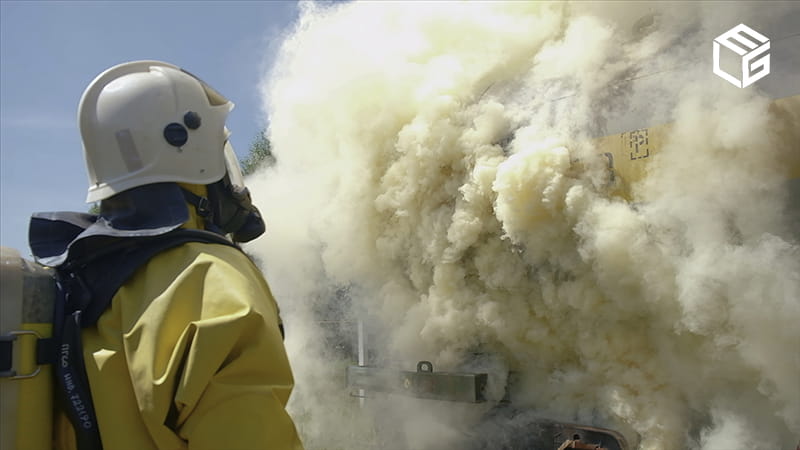
AFFF spreads a thin film across burning jet fuel and other petroleum products, cutting off oxygen and suppressing vapor release within seconds. That speed made it standard equipment for flight deck crews, air station fire departments, and salvage teams tasked with controlling shipboard and aircraft fires before they spread. Because Navy operations run on jet fuel and diesel around the clock, AFFF use was built into daily readiness drills, general quarters fire training, and real emergency response.
From the 1970s through the early 2000s, AFFF concentrate was stockpiled aboard every aircraft carrier, amphibious assault ship, and naval air station with an active flight line, making it one of the most widely handled substances in Navy firefighting operations.
How crash and salvage crews encountered AFFF
Sailors assigned to crash and salvage duties trained constantly, since flight deck fires and shipboard casualties require immediate, practiced response. Regular contact with AFFF came through several parts of the job:
- Aircraft carriers and naval air stations ran routine live fire exercises simulating aircraft crashes and fuel fires. Crash and salvage crews sprayed AFFF directly onto simulated fire pits, often multiple times per week, coating their turnout gear, hands, and faces with foam runoff.
- Ships were equipped with AFFF proportioning systems tied into fixed piping and hose reels throughout engineering spaces and hangar bays. Salvage crews tested and maintained these systems regularly, which meant handling concentrate during system checks even when no fire was present.
- When an actual aircraft fire or crash occurred, crash and salvage teams applied AFFF in large volumes to blanket burning fuel and wreckage, working close to the foam as it saturated the flight deck or hangar area.
- After drills and responses, sailors cleaned hoses, nozzles, and foam concentrate tanks by hand, extending their contact with AFFF well past the moment of application.
- Aviation Boatswain's Mates and Damage Controlmen assigned to crash and salvage divisions often rotated through multiple duty stations over a career, meaning many sailors carried this same routine across several ships or air stations rather than encountering it once.
Because carrier and air station operations rarely pause, sailors in these roles often accumulated exposure over an entire enlistment, not just during isolated incidents. Some sailors also described foam residue collecting in berthing areas and laundry facilities after drills, since turnout gear and uniforms saturated with AFFF were often cleaned using the same equipment used for everyday laundry.
Why this exposure matters
Older AFFF formulations contained PFOS and PFOA, PFAS compounds that do not break down in the body. Once absorbed through skin contact or inhaled during foam application, these chemicals build up in the bloodstream over years and can remain there long after a sailor leaves active duty. Studies conducted on firefighting populations, including military crash and salvage crews, have found associations between PFAS accumulation and several cancers.
Given the frequency of drills, the volume of foam used in shipboard and flight deck operations, and the physical closeness required to fight fuel fires, crash and salvage firefighters are among the Navy personnel with the highest documented occupational exposure to AFFF.
Scientific research has linked certain PFAS compounds found in AFFF to an increased risk of kidney cancer and testicular cancer. Because these cancers can take years or even decades to develop after exposure, many veterans are only now being diagnosed with conditions tied to foam they handled early in their Navy careers.
Who may have been exposed
Personnel who may have faced AFFF exposure through Navy crash and salvage duties include:
- Navy crash and salvage firefighters
- aircraft rescue and firefighting personnel assigned to carriers and air stations
- damage control personnel trained in shipboard firefighting
- flight deck fire party members
- personnel who maintained AFFF proportioning and piping systems
- firefighting instructors who ran live fire drills
- sailors assigned to hangar bay and engineering space fire stations
You may file an AFFF claim as a Navy firefighter
ELG Law has spent over three decades assisting individuals who developed cancer from toxic exposure. If you served as a Navy crash and salvage firefighter or in a related firefighting role and were later diagnosed with kidney cancer or testicular cancer, you may qualify for an AFFF claim. Our attorneys will review your service records to help establish proof of exposure and your medical documentation to confirm your diagnosis. Contact ELG Law for a free case evaluation as soon as possible.