-
About »
- Insulin MDL
-
Cases »
- Diseases
- Testimonials
- Government
- Contact
- Get Help Now
-

Injured or ill maritime workers who qualify as seamen can file Jones Act claims. In order to qualify for a Jones Act claim, a seaman must meet two requirements derived from Supreme Court precedents, such as Chandris, Inc. v. Latsis. A connection to a vessel or identifiable fleet in navigation for a significant period of time (typically at least 30% of working time), and the ability to contribute to the vessel's function.
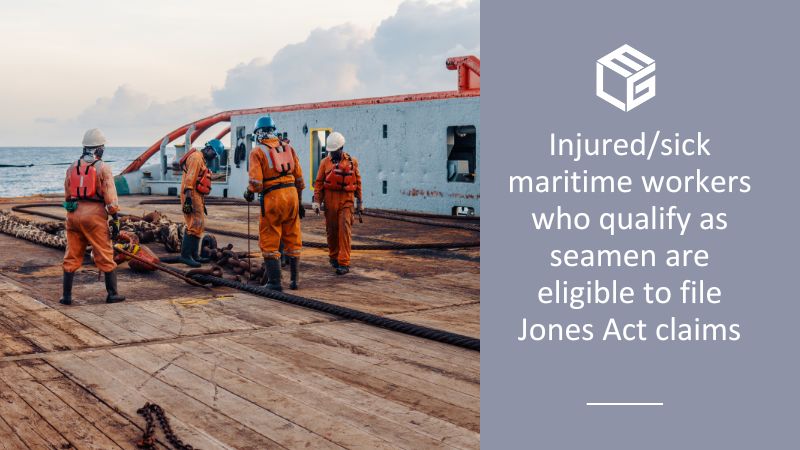
Workers must spend approximately 30% or more of their employment time in service of a vessel or fleet on navigable waters, including oceans, rivers, interstate lakes, and ports. This threshold measures your substantial connection to vessel operations rather than requiring exclusive shipboard work. The 30% calculation does not include time spent on transient assignments or land-based duties.
If an employee works on multiple vessels under the same leadership or operational control, he or she can combine their time to meet the 30% threshold.
Vessels must be in navigation, which means they must be afloat, mobile, and able to engage in maritime commerce. A vessel can be docked or temporarily stationary, as long as it's still a functional vessel capable of traveling, not a permanent mooring.
Your duties must aid vessel operations broadly, which courts interpret to include navigation, maintenance, cooking, cleaning, cargo handling, equipment repair, and other functions that support the vessel's mission. You do not need sailing expertise or navigation skills to qualify as a seaman if your work contributes to vessel function.
Deckhands, engineers, captains, cooks, electricians, stewards, and maintenance workers on ships, tugboats, fishing boats, supply vessels, and offshore platforms with vessel connections typically qualify as seamen. Workers performing diverse roles from navigation to food service may meet eligibility requirements when they satisfy the duration and contribution tests.
You must have sustained your injury or illness while performing vessel-related duties. Injuries occurring on navigable waters, aboard the vessel itself, or in areas directly related to vessel operations fall within Jones Act coverage. Your employer must operate vessels in navigation, making them subject to Jones Act liability as a maritime employer.
The Jones Act requires that your injury resulted from employer negligence or vessel unseaworthiness. Unlike workers' compensation systems, the Jones Act allows recovery of full damages, including pain and suffering, when you prove negligence or unseaworthiness contributed to your harm, even minimally.
Land-based maritime workers and those without substantial vessel connections are not covered by the Jones Act. Dockworkers, longshoremen, harbor workers, and others who work primarily on land or spend less than 30% of their time on vessels may be covered instead under the Longshore and Harbor Workers' Compensation Act or state Workers' Compensation laws, depending on their specific job duties and work locations.
Our attorneys have extensive experience evaluating whether workers meet Jones Act seaman status requirements based on vessel assignment percentages, job duties, and employment connections. If you are a seaman or a non-seaman, the legal framework and compensation you are entitled to depend on which category you fall under. To find out if you are eligible for Jones Act coverage and to determine the best path for recovering compensation, please contact the Environmental Litigation Group today.
Monday – Friday
8:00 AM – 5:00 PM
Saturday & Sunday
Closed
